California Exposed Firearm Permit: Requirements, Training & Range Qualification
By Security Training Finder Editorial Team
Requirements last verified
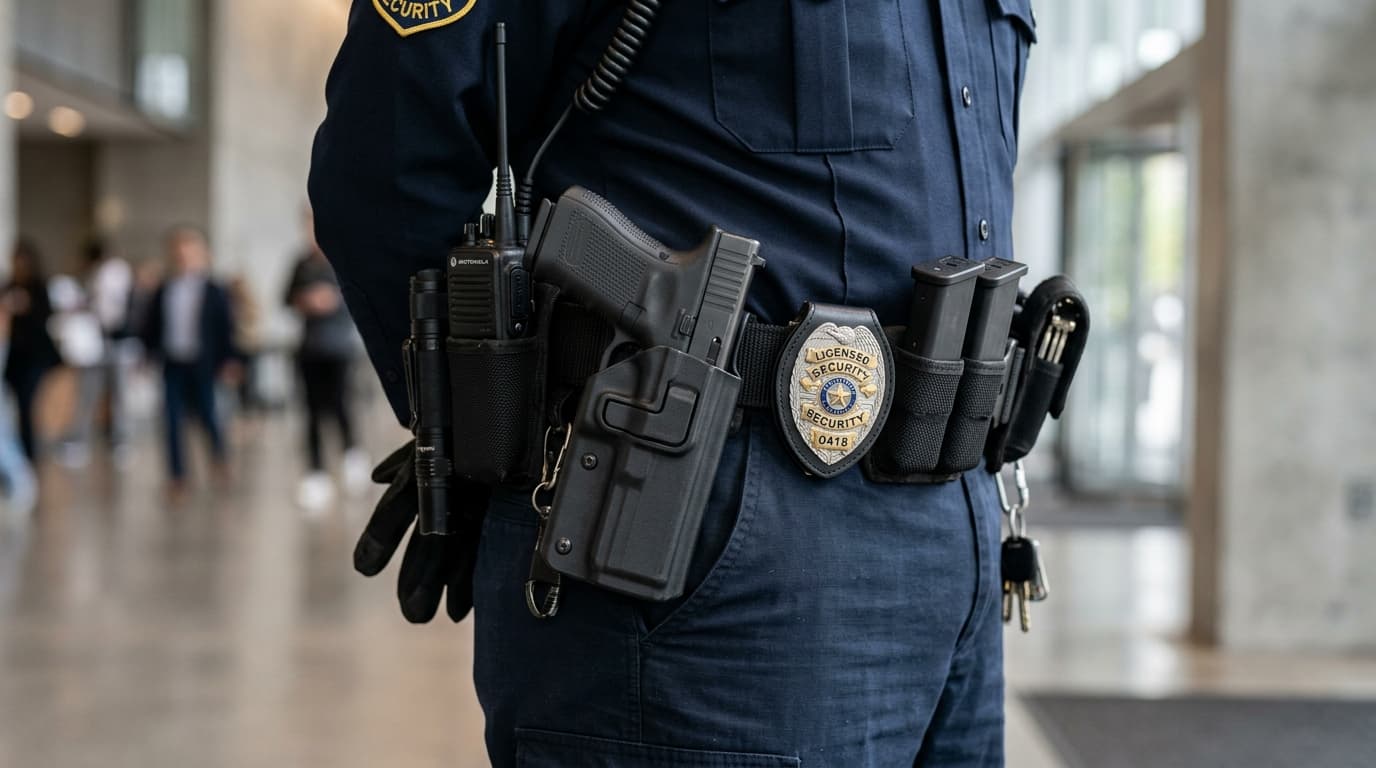
A California exposed firearm permit is the credential the Bureau of Security and Investigative Services (BSIS) issues so that a security guard or other licensee can carry a visible, loaded handgun on duty. BSIS also calls it a "Firearms Permit" or "Firearms Qualification Card (FQ)." To get one you must be at least 21. You must hold (or be applying for) a qualifying BSIS license or registration, such as a guard card. You need to pass an FBI and California DOJ background check, and if you are a security guard, pass a firearms assessment. You also have to complete BSIS firearms training at a Bureau-certified Training Facility Firearm (TFF) school, then qualify on the range with each caliber you plan to carry. The permit lasts two years. To renew it, you need four range qualifications during that term (BSIS Firearms Permit Fact Sheet).
Rules change, so check the current BSIS forms before you enroll or apply.
Who needs an exposed firearm permit
Under California law, a licensee, qualified manager, or security guard who may have to carry a firearm on the job must complete firearms training and receive a firearms qualification card before carrying. A licensee may not let an employee carry a firearm, loaded or unloaded, unless the employee holds a valid permit (Business and Professions Code §7583.22, reproduced in the BSIS Firearms Training Manual).
The permit can be associated with these BSIS credentials (Fact Sheet):
- Security guard registration (the guard card)
- Private investigator, or qualified manager of a PI
- Private patrol operator (PPO), or qualified manager of a PPO
- Alarm company operator, qualified manager, or registered alarm agent
The permit only covers the license types printed on the card. BSIS's own example: someone whose permit lists only a guard registration cannot work armed as a private investigator, even if they also hold a PI license, until that license is associated with the permit.
Three limits apply:
- Exposed only. The permit authorizes carrying an exposed (non-concealed) loaded firearm. It does not authorize concealed carry (Firearms Permit Initial Application). Concealed carry needs a separate permit from local law enforcement under the Penal Code.
- Employer type. A registered security guard may carry a firearm or baton only while employed by a licensed private patrol operator or by the state or a political subdivision (BPC §7583.3, reproduced in the Firearms Training Manual).
- Caliber. You may carry only the caliber(s) listed on your permit (BPC §7583.37).
No guard card yet? Start with how to get a guard card in California or the broader how to become a security guard guide.
Prerequisites
Age, status, and firearm eligibility
According to the BSIS Firearms Permit Fact Sheet, you must:
- Be a U.S. citizen or have permanent legal immigration status (BPC §§7542.2, 7583.23, 7596.3)
- Be at least 21 years old (same sections)
- Not be prohibited from owning or possessing a firearm under state or federal law (BPC §§7542.3, 7583.24, 7583.25, 7596.8)
- Hold, or be applying for, one of the qualifying licenses or registrations listed above
Background check
Applicants go through an FBI and California DOJ criminal history check by Live Scan fingerprinting, and they pay the Live Scan, FBI, and DOJ processing fees at the time they are fingerprinted. BSIS warns that, under FBI guidelines, you must submit your application to the Bureau before you complete the background check. Use the BSIS Live Scan form that matches your license (for example, "Security Guard w/Firearm"), because the wrong form delays processing (Fact Sheet; BSIS Live Scan page).
The firearms assessment (security guards)
A security guard applying for an initial firearms permit must pass an assessment within the six months before submitting the application. The assessment checks whether the guard has "appropriate judgment, restraint, and self-control to carry a firearm while on duty" (BPC §§7583.23 and 7583.47, cited in the Fact Sheet).
According to the BSIS firearms assessment page:
- The assessment is the Sixteen Personality Factor Questionnaire (16PF), a personality test. It is given at PSI Services testing centers.
- The requirement started with a law effective July 1, 2018. Since January 1, 2022, you must pass the assessment before you submit your initial permit application. An application sent without a passing result is considered deficient (Initial Application).
- You pay the fee directly to the vendor. The assessment page lists it as $69.
- After a "did not demonstrate" result, you may retake the assessment after 180 days.
Associating a guard registration with an existing permit can also require it.
Power to Arrest training
Firearms applicants must also have completed Power to Arrest training (Fact Sheet). Guard card applicants complete this training anyway. See California Power to Arrest and Use of Force training.
The BSIS firearms course
The course content is set by Title 16, California Code of Regulations §635 and reprinted in the BSIS Firearms Training Manual. Only a Bureau-approved Firearms Training Instructor at a Bureau-approved Firearms Training Facility can teach it. Classroom training must be done in a traditional classroom, and it must be finished before range training and before any attempt at range qualification.
Classroom (minimum 8 hours)
The regulation sets a minimum time for each subject. Together they add up to 8 hours:
| Subject (CCR §635) | Minimum time |
|---|---|
| Registration and administration | ½ hour |
| Laws and regulations for firearms permits | ½ hour |
| Laws on possessing and carrying firearms | ½ hour |
| Shooting incidents | ½ hour |
| Effects of firearms use | ½ hour |
| Nomenclature (revolver, semi-automatic, ammunition) | 1 hour |
| Firearms safety, inspection, and maintenance | 1 hour |
| Appropriate use of force | 3½ hours |
| Written examination | As needed to pass |
The use-of-force block covers objectively reasonable force, the duty to intercede, de-escalation, bias, interacting with people with disabilities or behavioral health issues, shoot/don't-shoot scenarios, and active shooter situations.
Written exam
You take the written exam after the classroom instruction. BSIS documents give slightly different passing scores:
- The current Firearms Permit Initial Application (rev. October 2025) requires 86% or greater for an initial permit. The Firearms Training Manual says this is 45 of 52 questions.
- The Fact Sheet and the manual's renewal section use 85% for the renewal exam and for adding a caliber.
If you fail the written exam, you must repeat the entire classroom portion before you retake it (BPC §7585.6(c), cited in the manual).
Range training and qualification
Range training is at least 1 hour on weapon handling and shooting fundamentals and 1 hour of range preparation. That is followed by supervised range training, which lasts until the instructor judges that you can draw and fire safely (CCR §635(b)). Then comes the qualification (Firearms Training Manual; Initial Application):
- Live ammunition only. You cannot use a firearm simulator for the initial qualification. The application describes 50 rounds for practice and 50 rounds for score.
- Passing score: 80%, which is 200 of 250 points, on a human-silhouette target, with 5 points for each hit inside the scoring rings.
- Timing: You must qualify within 30 days of the classroom instruction (BPC §7585.6).
The instructor certifies your training on the application and issues a Certificate of Proficiency listing each caliber you qualified with. Keep copies.
Caliber-specific qualification
You must qualify with the same caliber you will carry on duty. If you want to carry more than one, you must qualify separately with each caliber you want listed. The calibers allowed under CCR §635 are .357, .38, .45, 9mm, 10mm, .40, and .380 (Firearms Training Manual).
To add a caliber to an existing permit, BSIS requires all of the following (Fact Sheet):
- A current permit
- At least 8 hours of classroom instruction
- A passing score of 85% or higher on the written exam
- Successful range training
- The Add Caliber form
A $25 fee gets you a replacement card that shows the new caliber. From then on, you must qualify with that caliber at every remaining requalification of the permit term.
Where to train: TFF schools
Only Bureau-certified Training Facility Firearm (TFF) schools, with Bureau-approved instructors, can teach the course and run qualifications. The BSIS public licensee file we analyzed lists 333 Training Facility Firearm (TFF) license records among 898 deduplicated training-licensed organizations. Not all of them train the public, because some organizations train only their own employees.
Before you pay, confirm the facility's and the instructor's license status with BSIS's Verify a License tool. To compare options:
- Find armed (firearms) training schools in California
- Browse all California schools
- How we verify security training schools
How to apply
- Pass the firearms assessment (if you are a security guard) within six months before you apply.
- Complete Power to Arrest and the BSIS firearms course, and pass the written exam and the range qualification for each caliber.
- Have your instructor complete the certification page of the Firearms Permit Initial Application.
- Submit the application and fee. You can apply online through BreEZe, where you upload the completed application as an attachment, or by mail to BSIS, P.O. Box 989002, West Sacramento, CA 95798-9002. BSIS says online applications skip the cashiering office and can be processed up to two weeks faster.
- Complete Live Scan using the correct firearm Live Scan form, after you submit the application.
BSIS asks applicants to allow 6 to 8 weeks after payment is cashiered; DOJ and FBI responses can make it longer (Fact Sheet).
Fees
According to the BSIS fee schedule, which applies to applications submitted on or after October 1, 2025:
| Item | BSIS fee |
|---|---|
| Firearms permit, initial application | $110 |
| Firearms permit, renewal | $126 ($88 renewal fee + $38 DOJ fee) |
| Replacement permit card | $25 |
Assessment, Live Scan, tuition, range, and ammunition costs are separate. For a full cost breakdown, see how much a guard card costs.
Requalification and renewal
A firearms permit expires two years after it is issued and cannot be renewed once it has expired. If it lapses, you have to apply for a new permit. To renew, you must (Fact Sheet; CCR §633 in the Firearms Training Manual):
- Complete four range qualifications: two in each 12-month period of the term, with no two closer than four months apart.
- Use live ammunition for at least one of each year's two qualifications. Only one qualification per 12-month period may be done on a firearm simulator, and that simulator must meet the CCR §631 standards (realistic weight, recoil, action, flash, and sound; caliber-matched; simulated loading and reloading).
- Take the two-hour review course before each qualification. It covers the law on use of deadly force and de-escalation.
- Pass the written exam (85%) once during the term. BSIS recommends taking it in the second year.
- Qualify with every caliber listed on the permit, each time.
- Submit the renewal application with all four certification pages from your TFF, the DOJ Biennial Firearms Permit Qualification Application (BOF 4040A), and the renewal fee. It must arrive at least 60 days before expiration. BSIS returns applications that arrive more than three months early.
All qualifications must be done at a Bureau-certified TFF by a Bureau-approved instructor. The Fact Sheet includes an optional suggested schedule for each expiration month.
Frequently asked questions
How old do you have to be for a California exposed firearm permit?
21 (Fact Sheet).
Is there a psychological evaluation?
Security guards must pass a personality-based assessment, the 16PF, administered by PSI. It checks judgment, restraint, and self-control. BSIS calls it an "assessment," and its pages do not describe a clinical evaluation by a psychologist (BSIS firearms assessment).
How many hours is the firearms course?
At least 8 classroom hours under CCR §635, plus at least 2 hours of range instruction, supervised practice as needed, and the qualification. Schools may schedule more.
How many times a year do I have to qualify?
Twice in each 12-month period, at least four months apart, for a total of four qualifications per two-year term (Fact Sheet).
Are peace officers exempt from the training?
Some active-duty peace officers can submit proof of completed firearms training instead of taking the BSIS course. See the BSIS peace officer FAQ.
For an overview of requirements in other states, see security guard license requirements by state. If you also plan to carry an impact weapon, read the California baton permit guide.
Sources
- BSIS, Firearms Permit Fact Sheet (rev. January 2025)
- BSIS, Firearms Permit Initial Application (rev. October 2025)
- BSIS, Firearms Permit Renewal Application
- BSIS, Firearms Training Manual (July 2023), which reproduces Business and Professions Code §§7583.3, 7583.5, 7583.22, 7583.37, and 7585.6 and Title 16 CCR §§631–635.1
- BSIS, Firearms Permit Assessment information
- BSIS, Licensing Fees (effective October 1, 2025)
- BSIS, Live Scan forms and information
- BSIS, Verify a License
- BSIS, Peace Officer FAQ
- California Business and Professions Code, Division 3, Chapter 11.5 (California Legislative Information)
- Security Training Finder analysis of the BSIS public licensee file (October 2026)
Licensing rules change. Confirm current requirements with your state's licensing agency before enrolling. How we verify schools