How to Become a Security Guard: The Complete 2026 Guide
By Security Training Finder Editorial Team
Requirements last verified
To become a security guard in the US, you generally need to be at least 18, pass a fingerprint-based background check, finish your state's required pre-license training at an approved school, and get a state license or registration (often called a "guard card"). The details depend on your state. As of October 2026, California requires 8 hours of training before registration, Florida requires 40, New York requires 8 before you start work, and Texas requires its Level II course. Most people can go from first class to first shift in a few weeks, though processing times vary by state.
This guide covers each step, the difference between armed and unarmed work, specialized career paths, what the job pays according to the U.S. Bureau of Labor Statistics, and how to pick a training school. Every licensing requirement links to the state regulator it comes from. Requirements change, so confirm the current rules with your state before you enroll or apply.
Key takeaways
- Most states license security guards. The Bureau of Labor Statistics notes that "most states require that security guards be licensed by the state in which they work."
- Training comes first. Most states require a pre-license course at a state-approved school, from 8 hours (California, New York) to 40 hours (Florida).
- Background checks are fingerprint-based. Your state regulator, not the school or the employer, decides whether you're eligible.
- Armed work is a separate license with more training, firearms qualification, and stricter screening.
- Pay: the median annual wage for security guards was $38,020 in May 2025, per the BLS.
What security guards do
Before you invest in training, it helps to know what the job involves. According to the BLS, security guards typically:
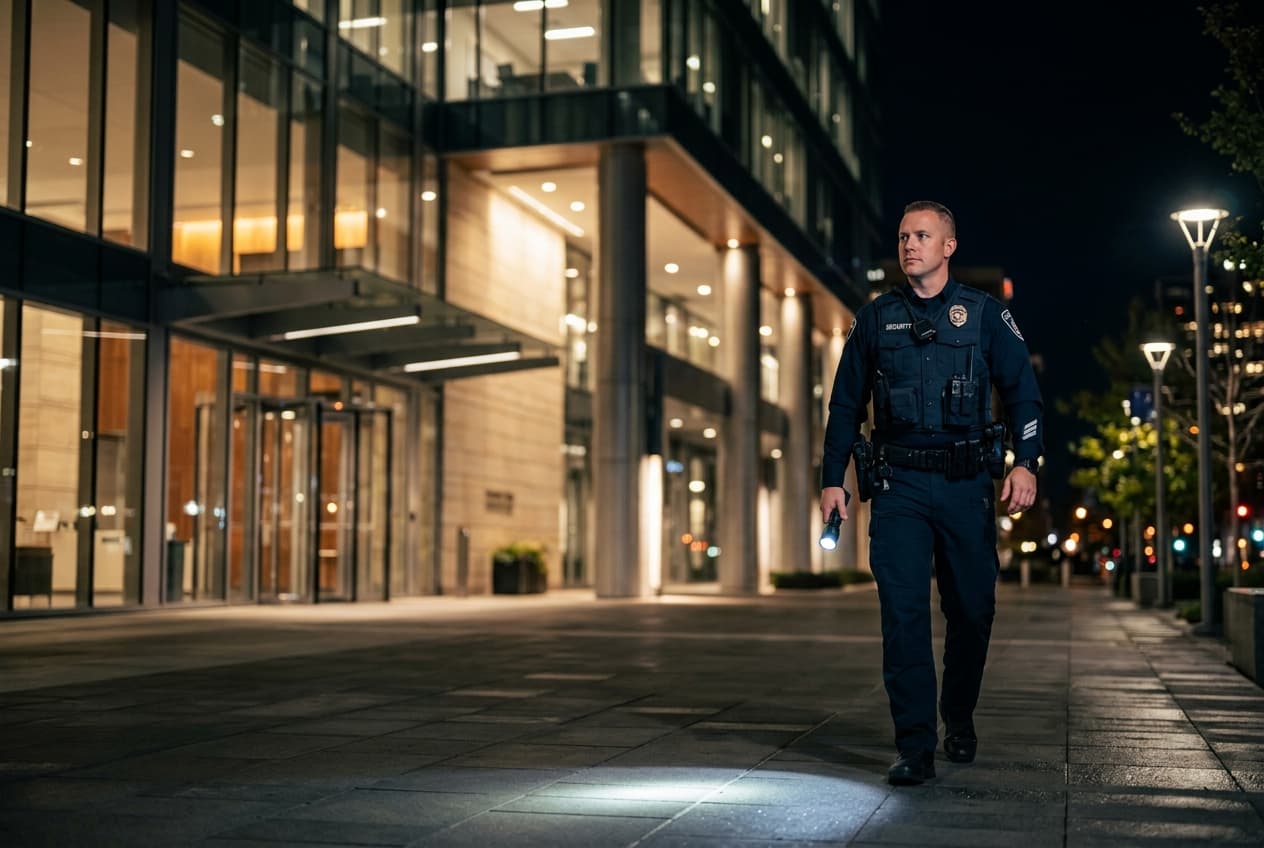
- Patrol property and conduct security checks over a specified area
- Enforce the rules and regulations of an employer's property
- Monitor alarms and video-surveillance systems
- Control building access for employees and visitors
- Respond to emergencies and deter criminal activity
- Write reports on what they observed while on duty
The BLS also notes that guards usually work shifts of about 8 hours on rotating schedules, and that night shifts are common because many buildings are open around the clock. Most guards work full time. If you need a predictable daytime schedule, ask about shift assignments before you accept a job, since newer guards are often placed on whatever shifts are open.
Report writing matters more than many newcomers expect. Your notes and incident reports may be read by supervisors, clients, insurers, or police, so clear, factual writing is part of the job. Many states' required courses cover observation and documentation for this reason. California, for example, includes it among its mandatory skills courses (BSIS).
Step-by-step: how to become a security guard
Step 1: Check your state's rules
Security guard licensing is handled state by state, so there is no single national license. Before spending money on a class, find out:
- Who regulates guards in your state. In California it's the Bureau of Security and Investigative Services (BSIS); in Texas, the Department of Public Safety's Private Security Program; in Florida, the Department of Agriculture and Consumer Services (FDACS); in New York, the Department of State, with training overseen by the Division of Criminal Justice Services (DCJS).
- What the license is called. A "guard card" in California is officially a Security Guard Registration. Texas issues non-commissioned and commissioned security officer licenses. Florida issues a Class "D" Security Officer License.
- How much training is required, and when. Some states require all training before you apply. Others split it into a short pre-license course plus more training after you're hired.
Our security guard license requirements by state guide compares the rules side by side. If you're in California, start with how to get a guard card in California.
Step 2: Meet the basic eligibility requirements
Eligibility rules vary, but most states share a common core:
- Minimum age. California requires applicants to be at least 18. So do Florida and New York. Armed positions can carry a higher age requirement in some states.
- Work authorization. Florida, for example, requires applicants to be a U.S. citizen, a legal resident alien, or authorized to work in the U.S. (FDACS).
- A background check. Every state in our examples runs a fingerprint-based criminal history check through state and federal (FBI) databases.
About criminal records: each state has its own rules about which convictions or charges affect eligibility, and the regulator makes the decision case by case under state law. We can't tell you whether a particular record will disqualify you. If you have concerns, read your regulator's published criteria or contact the regulator directly before you pay for training.
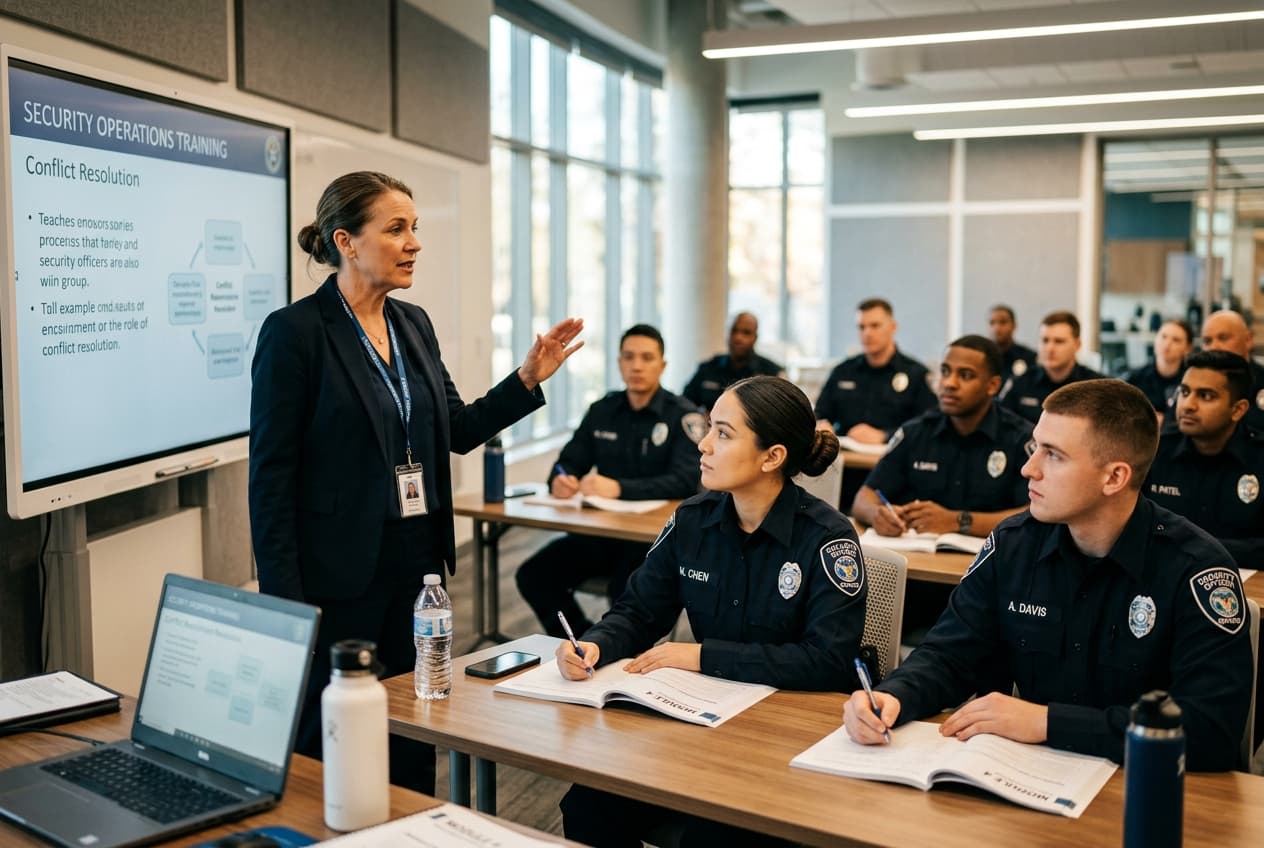
Step 3: Complete pre-license training at a licensed school
Most states require you to finish an approved course before your license is issued, and they only accept certificates from approved providers. Examples:
- California: The 8-hour Power to Arrest and Appropriate Use of Force course (3 hours of Power to Arrest, 5 hours of Appropriate Use of Force) must be completed before BSIS issues a registration. BSIS notes that at least half of that course must be taught in person, and that the former 4-hour Weapons of Mass Destruction course is now an elective (BSIS training notice; BSIS fact sheet). Our Power to Arrest training guide explains what the course covers.
- Texas: The Level II Training Course and test are required for all security officers, and applicants submit training certificates with their application (Texas DPS).
- Florida: Class D applicants need at least 40 hours of professional training from a school or training facility licensed by FDACS (FDACS). State law allows in-person instruction or live online instruction through the licensed school's secure website (Fla. Stat. § 493.6303).
- New York: An 8-Hour Pre-Assignment Training Course comes first, followed by a 16-Hour On-the-Job Training Course within 90 days of being hired (NYS DCJS).
Make sure your school is approved by your state. A certificate from an unapproved provider may not count, which means paying for training twice. See "How to pick a training school" below.
Step 4: Get fingerprinted for the background check
States collect fingerprints electronically through approved vendors:
- California uses Live Scan. Applicants pay the Live Scan, DOJ, and FBI processing fees when they're fingerprinted (BSIS).
- Texas requires electronic fingerprints through IdentoGO unless you qualify for the alternative process. After you submit your application in the TOPS online system, IdentoGO emails you to schedule an appointment (Texas DPS).
- New York lists a $102.50 fingerprint fee, payable to IDEMIA (NY Department of State).
Fingerprint results go straight to the regulator, and in most states a big part of the wait is the time it takes for those results to come back. Our guide on how long it takes to get a guard card breaks down the timeline by state.
Step 5: Apply for your license or registration
Applications typically include the application form, your training certificate(s), proof of fingerprinting, and a fee.
- California: Apply online through BreEZe or by paper application. BSIS says to "allow approximately 4-6 weeks" for processing, and possibly longer depending on DOJ and FBI responses (BSIS).
- Texas: Apply and pay through TOPS (Texas Online Private Security), where you can track your status in real time (Texas DPS).
- Florida: Class D applicants don't pay an application fee but do pay fingerprint processing and retention fees (Fla. Stat. § 493.6105).
- New York: Submit the Employee Statement and Security Guard Application (DOS-1206) with the DMV consent form, proof of fingerprinting, and the $36 application fee (NY Department of State).
For a full breakdown of training, state fees, and fingerprint costs, see how much a guard card costs.
Step 6: Get hired
Some states let you start working before the physical card arrives, but only under specific conditions:
- In California, you may work once BSIS has approved your registration, as long as you carry a hard-copy printout of the approval and valid ID (BSIS).
- In Texas, an applicant may be employed in an unarmed capacity once a substantially complete application (including fees and electronic fingerprints) has been submitted and certain conditions are met, including an employer background check. This doesn't apply to armed work (Texas DPS, Working Prior to Licensure).
Employers include contract security companies, which place guards at client sites, and businesses that hire their own in-house security staff. When you interview, ask what training the employer provides after hire. In states like California and New York, a lot of the required training happens in your first months on the job.
Step 7: Keep up with ongoing training and renewal
Getting licensed isn't the end of your training:
- California: 32 hours of security officer skills training within the first six months of registration, then 8 hours of continuing training every year (BSIS). BSIS asks for renewal applications at least 60 days before expiration and cancels registrations that aren't renewed within 60 days after expiration.
- Texas: New licenses expire two years after issuance, and you can renew online up to 180 days early (Texas DPS). Commissioned (armed) officers and personal protection officers must complete 6 hours of continuing education (Texas DPS).
- New York: An 8-Hour Annual In-Service Training Course every year (NYS DCJS).
Keep every training certificate. California, for example, requires guards to keep their certificates of completion until the registration expires.
State examples at a glance
This table summarizes four large states as of October 5, 2026. It doesn't cover every requirement, so check the regulator's page before you apply.
| State | Regulator | License name | Training before licensing | Training after licensing |
|---|---|---|---|---|
| California | BSIS | Security Guard Registration ("guard card") | 8 hrs Power to Arrest & Appropriate Use of Force | 32 hrs within 6 months; 8 hrs every year |
| Texas | Texas DPS | Non-commissioned Security Officer | Level II course and test | Commissioned officers: 6 hrs CE |
| Florida | FDACS | Class "D" Security Officer License | 40 hrs at an FDACS-licensed school | Not covered on the FDACS requirements page; check with FDACS |
| New York | NY DOS / DCJS | Security Guard Registration | 8-hr Pre-Assignment course | 16-hr OJT within 90 days of hire; 8 hrs every year |
Armed vs. unarmed security guards
Most entry-level jobs are unarmed. Armed work usually pays more and comes with more responsibility, more training, and a separate license or permit. The BLS notes that "positions for armed guards have more stringent background checks and entry requirements than do those for unarmed guards."
Examples of armed requirements:
- California: Armed guards need an Exposed Firearm Permit on top of the guard card, which includes a firearms course and range qualification. BSIS added appropriate-use-of-force content to the initial firearms course and limits approved calibers (BSIS notice). See our California exposed firearm permit guide. Carrying a baton on duty requires its own permit too; see the California baton permit guide.
- Texas: Commissioned security officers must complete the Level III Training Course (minimum 45 hours) and test, including a course of fire. Firearm proficiency must be shown within 90 days of the application date (Texas DPS).
- Florida: A Class "G" statewide firearm license requires 28 hours of range and classroom training, including at least 8 hours of in-person range training (Fla. Stat. § 493.6105).
- New York: Armed guards complete a 47-Hour Firearms Training Course and an 8-Hour Annual Firearms Training Course. A valid pistol license and a security guard registration are prerequisites for the firearms course (NYS DCJS).
A common path is to start unarmed, get experience, and then add firearms or other weapons permits once you know the work suits you.
Specialized security paths
Once you're licensed, there are several directions you can take. These roles still require the base license in states that regulate guards, and some require more.
- Event security. Concerts, sports venues, and festivals hire large numbers of guards, often part time or seasonally. The work centers on crowd management, bag checks, and de-escalation.
- Hospital and healthcare security. Hospitals hire security staff for emergency departments, visitor control, and patient-safety incidents. The BLS reports a median annual wage of $44,920 for security guards in health care and social assistance, among the highest of the major employing industries (BLS). De-escalation and first aid training help here.
- Executive protection. Protecting individuals usually takes experience and advanced training. Some states license it separately. Texas, for example, requires personal protection officers to complete the Level IV Training Course (minimum 15 hours) and test in addition to Level II and Level III (Texas DPS).
- Proprietary (in-house) security officers. Some guards work directly for one business rather than a contract security company. California regulates proprietary private security officers separately, and BSIS requires them to complete the full 8-hour Power to Arrest and Appropriate Use of Force course (BSIS notice).
Security guard pay and job outlook
Figures below are from the BLS Occupational Outlook Handbook, last modified August 27, 2026 (BLS):
- Median annual wage: $38,020 for security guards in May 2025. The lowest 10 percent earned less than $30,210 and the highest 10 percent more than $58,840.
- Pay by industry (median): health care and social assistance $44,920; educational services $44,250; accommodation and food services $37,640; investigation, guard, and armored car services $37,350; retail trade $35,640.
- Job outlook: Employment of security guards is projected to grow about 1 percent from 2025 to 2035, slower than average. The BLS still projects about 157,200 openings per year for security guards and gambling surveillance officers combined, mostly to replace workers who change occupations or leave the labor force.
- Education: The typical entry-level education is a high school diploma or equivalent. The BLS notes that most guards learn the job in a few weeks.
In plain terms, this is a large field with steady turnover, so jobs open up regularly even though overall growth is slow. Pay varies by state, industry, shift, and whether you're armed, so check local job listings for current rates in your area.
How to pick a training school
Your school determines whether your certificate counts, so it's worth a few minutes of checking:
- Confirm the school is approved by your state. Look it up in your regulator's license search (in California, BSIS issues training facility licenses). Every school listed in our directory is checked against state license records. Our verification methodology explains how.
- Confirm it teaches the course you need. A school approved for unarmed training isn't necessarily approved for firearms. Ask which certificate you'll receive and which regulator recognizes it.
- Check the format rules. Some states limit online training. California requires at least half of the Power to Arrest and Appropriate Use of Force course to be taught in person (BSIS), and Florida allows live online instruction only through the licensed school's secure website (Fla. Stat. § 493.6303).
- Get the full price in writing, including the course, materials, range fees, and whether fingerprinting or application help is included.
- Ask about scheduling and job placement. Some schools are run by security companies that train their own hires. Others train the general public. Both can be legitimate, but they serve different needs.
Ready to compare options? Search licensed training schools or browse licensed schools in California.
Frequently asked questions
Do I need a license to be a security guard?
In most states, yes. The BLS notes that most states require security guards to be licensed by the state where they work. Rules differ widely, so check your state regulator or our state-by-state requirements guide.
How long does it take to become a security guard?
Training can take anywhere from a single day to about a week, depending on the state. Processing then adds anywhere from days to several weeks. New York's Department of State reported that applications were typically processed in less than five business days in its 2022 annual report, while California's BSIS says to allow about 4–6 weeks. See how long it takes to get a guard card.
How much does it cost to become a security guard?
You'll typically pay for training, fingerprinting, and a state application fee. For example, New York lists a $36 application fee and a $102.50 fingerprint fee (NY DOS), while Florida charges no Class D application fee but does charge fingerprint fees (Fla. Stat. § 493.6105). See how much a guard card costs.
Can I take security guard training online?
It depends on the state and the course. Florida allows live online instruction through a licensed school's secure website. California requires at least half of the Power to Arrest and Appropriate Use of Force course to be taught in person. Ask your school exactly what its state allows.
Can I become a security guard with a criminal record?
It depends on your state's law and the details of the record, and the regulator decides each case. We can't predict the outcome for any individual. Review your regulator's eligibility rules or contact the regulator before paying for training.
Can I work while my application is pending?
In some states, under conditions. California allows work once BSIS has approved you and you carry a printout of the approval. Texas allows unarmed work after a substantially complete application is submitted and the employer completes a background check. Check your state's rules.
Do I need a high school diploma?
The BLS lists a high school diploma or equivalent as the typical entry-level education for security guards. Whether it's legally required depends on your state and employer.
Is a guard card valid in other states?
Generally, no. Licenses are issued by individual states, so if you move you'll usually need to meet the new state's requirements. Check with the regulator in the state where you plan to work.
Sources
- U.S. Bureau of Labor Statistics, Occupational Outlook Handbook, Security Guards and Gambling Surveillance Officers (last modified Aug. 27, 2026): https://www.bls.gov/ooh/protective-service/security-guards.htm
- California BSIS, Security Guard Registration fact sheet: https://www.bsis.ca.gov/forms_pubs/guard_fact.shtml
- California BSIS, Power to Arrest and Firearms Qualification training changes notice: https://www.bsis.ca.gov/forms_pubs/pta_fq_training_change.pdf
- California BSIS, Security Guard Training Regulation: https://www.bsis.ca.gov/industries/g_train.shtml
- Texas DPS, Private Security Training and Continuing Education: https://www.dps.texas.gov/section/private-security/training-and-continuing-education
- Texas DPS, Individual License Questions: https://www.dps.texas.gov/section/private-security/faq/individual-license-questions
- Texas DPS, Fingerprinting Instructions: https://www.dps.texas.gov/section/private-security/fingerprinting-instructions
- Texas DPS, Working Prior to Licensure: https://www.dps.texas.gov/section/private-security/working-prior-licensure
- Florida FDACS, Class "D" Security Officer License Requirements: https://www.fdacs.gov/Business-Services/Private-Security-Licenses/Class-D-Security-Officer-License-Requirements
- Florida Statutes § 493.6303 (training requirements): http://www.leg.state.fl.us/statutes/index.cfm?App_mode=Display_Statute&URL=0400-0499/0493/Sections/0493.6303.html
- Florida Statutes § 493.6105 (initial application; Class G training): http://www.leg.state.fl.us/statutes/index.cfm?App_mode=Display_Statute&URL=0400-0499/0493/Sections/0493.6105.html
- New York Department of State, Become a Security Guard: https://dos.ny.gov/become-security-guard
- New York Department of State, 2022 Annual Report: Administration of the Security Guard Act: https://dos.ny.gov/security-guard-annual-report-2022
- New York DCJS, Security Guard Training: https://www.criminaljustice.ny.gov/ops/sgtraining/index.htm
Licensing rules change. Confirm current requirements with your state's licensing agency before enrolling. How we verify schools