How Long Does It Take to Get a Guard Card? State-by-State Timelines
By Security Training Finder Editorial Team
Requirements last verified
Getting a guard card usually takes anywhere from a few days to several weeks, depending on your state. Pre-license training ranges from one day (California's 8-hour course) to about a week (Florida's 40 hours). After that, the wait comes down to how long your background check and application take to process. California's Bureau of Security and Investigative Services (BSIS) says to allow about 4–6 weeks for processing. New York's Department of State has reported that most applications are processed in under five business days. Other regulators don't publish a standard processing time.
Below, we break the timeline into its three parts, compare four large states using figures from their regulators (current as of October 5, 2026), and explain what slows applications down and what you can do to speed things up. For the full process from start to finish, see our guide on how to become a security guard.
The three parts of the guard card timeline
1. Training time
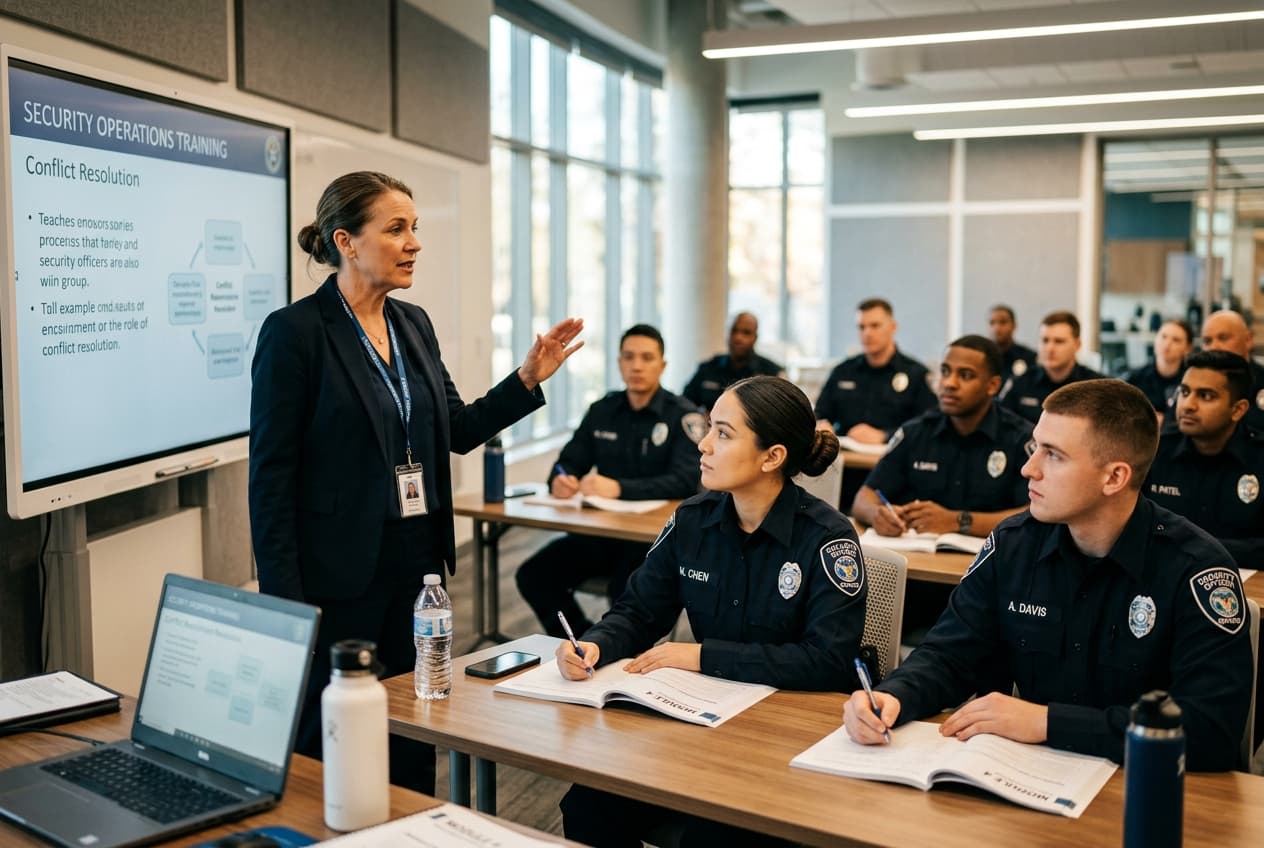
Most states require a pre-license course at an approved school before you apply. Classroom hours set the minimum, but scheduling sets the real pace. An 8-hour course often fits into one day, while a 40-hour course usually means a full work week, or longer if you take evening or weekend classes.
Some states also require training after you're licensed. That doesn't delay your card, but it does come with deadlines. California guards must finish 32 more hours within six months of registration (BSIS). New York guards must complete a 16-hour on-the-job course within 90 days of being hired (NYS DCJS).
2. Fingerprint and background check processing
Every state in this guide requires electronic fingerprints for a state and FBI criminal history check. Getting fingerprinted takes one appointment, but the results can take longer to come back. California's BSIS says processing "may be longer depending on the time it takes for the Bureau to receive responses from the DOJ and FBI" (BSIS). On the faster end, New York's Division of Criminal Justice Services reported that in 2022, 99% of security guard fingerprint submissions were processed in under an hour and more than 99.9% in under a day (NY DOS 2022 annual report).
3. Application processing
Once the regulator has your application, training certificates, fees, and fingerprint results, it reviews your file and decides whether to issue the license. Incomplete applications are the most common cause of avoidable delays (see below). If anything in your background needs closer review, the regulator decides eligibility under state law, and that review can take longer. We can't predict how long any individual case will take.
Guard card timelines by state
| State | Pre-license training (official) | Processing guidance published by the regulator | Can you work before the card arrives? |
|---|---|---|---|
| California | 8 hrs: Power to Arrest (3) + Appropriate Use of Force (5) (BSIS) | "Allow approximately 4-6 weeks," possibly longer depending on DOJ/FBI responses (BSIS) | Yes, once BSIS has approved you and you carry a printout of the approval plus valid ID |
| Texas | Level II Training Course and test (Texas DPS) | Online (TOPS) applications have "reduced processing time"; no standard time published. Manual paper applications "may take 4-8 weeks" (Texas DPS) | Unarmed only, under conditions: at least 48 hours after a substantially complete application, plus an employer background check (Texas DPS) |
| Florida | 40 hrs at an FDACS-licensed school (FDACS) | Varies; check status with FDACS | Not stated on the FDACS requirements page; check with FDACS |
| New York | 8-hr Pre-Assignment Training Course (NYS DCJS) | "Typically processed in less than five business days" (2022 annual report, the latest posted) (NY DOS) | Not stated on the pages we reviewed; check with NY DOS |
A few notes on the table:
- Texas Level II hours. The DPS training page requires the Level II course and test but doesn't list a minimum number of hours. The state's TEEX program, for example, lists its Level II course at 6 hours. Armed (commissioned) officers also need the Level III course (minimum 45 hours), and firearm proficiency must be shown within 90 days of the application date (Texas DPS).
- New York processing figure. The "less than five business days" statement comes from the Department of State's 2022 annual report. It's the most recent report on the agency's annual reports page, so current times may differ.
- Armed licenses take longer. Firearm permits add more training and qualification requirements. In California, for example, armed guards need an exposed firearm permit in addition to the guard card.
For other states, see our security guard license requirements by state. California readers can find step-by-step instructions in how to get a guard card in California.
What slows a guard card application down
Regulators don't publish breakdowns of what causes delays, but their instructions point to the usual problems:
- An incomplete application. Texas DPS notes that the 48-hour work allowance depends on a "substantially complete application (including fees and electronic fingerprints)" (Texas DPS). A missing fee, signature, or certificate can stop the clock.
- Training from an unapproved provider. States accept certificates only from approved schools. Florida, for example, requires training from a school or training facility licensed by FDACS. If your certificate isn't accepted, you'll have to retake the course.
- Waiting on fingerprint results. California explicitly says processing can run longer while BSIS waits on DOJ and FBI responses.
- Paper instead of online. In Texas, paper applications may take 4–8 weeks, and DPS points to reduced processing times for online applications.
- Background issues that need review. If your history needs a closer look, the regulator may take longer to decide. Only the regulator can determine eligibility.
- Letting paperwork go stale. Fingerprint receipts and training certificates can come with their own time limits. If your state sets one, submit your application before it runs out so you don't have to redo that step.
How to speed up your guard card
You can't control a regulator's queue, but you can avoid being the reason your file stalls:
- Choose a state-approved school first. Check the school against your regulator's records before you enroll. Our school verification methodology explains how we check the schools in our directory, and you can search licensed schools or browse California schools.
- Book fingerprints early. Schedule Live Scan in California, or IdentoGO in Texas and New York, as soon as your state's process allows. In Texas, IdentoGO emails you to schedule after you submit your TOPS application (Texas DPS).
- Apply online where you can. California accepts applications through BreEZe, and Texas uses TOPS, which offers real-time status tracking.
- Double-check every page. Make sure names match your ID, all signatures and fees are included, and every training certificate is attached.
- Keep copies of everything. Save your certificates, fingerprint receipt, and confirmation numbers so you can answer questions quickly.
- Check your status yourself. Use your regulator's online lookup or portal instead of waiting for mail.
- Plan for post-hire training. In California and New York, schedule your post-licensing training right away so you don't miss a deadline once you start working.
Budget for the fees too. See how much a guard card costs.
Frequently asked questions
Can I get a guard card in one day?
You can often finish the training in one day in states with an 8-hour pre-license course, like California and New York. Getting the license itself takes longer because of fingerprint and application processing.
How long does BSIS take to process a guard card in California?
BSIS says to allow approximately 4–6 weeks, and that it may take longer depending on DOJ and FBI responses (BSIS).
Can I work while my guard card is processing?
In California, yes, once BSIS approves you and you carry a printout of the approval and valid ID. In Texas, unarmed work may be allowed after a substantially complete application is submitted and the employer runs a background check. Other states have their own rules.
How do I check my guard card status?
Use your regulator's online system: BreEZe in California, TOPS in Texas. Other states offer license lookups or contact lines on their regulator websites.
Does an armed license take longer?
Usually, yes. It requires extra training and firearms qualification. Texas, for example, requires the 45-hour Level III course with a course of fire, and firearm proficiency must be shown within 90 days of the application date.
How long is a guard card valid?
It depends on the state. A new Texas license expires two years after it's issued (Texas DPS). California requires renewal applications at least 60 days before expiration (BSIS).
Sources
- California BSIS, Security Guard Registration fact sheet: https://www.bsis.ca.gov/forms_pubs/guard_fact.shtml
- California BSIS, Power to Arrest and Firearms Qualification training changes notice: https://www.bsis.ca.gov/forms_pubs/pta_fq_training_change.pdf
- Texas DPS, Private Security Training and Continuing Education: https://www.dps.texas.gov/section/private-security/training-and-continuing-education
- Texas DPS, TOPS FAQs: https://www.dps.texas.gov/section/private-security/faq/texas-online-private-security-tops-faqs
- Texas DPS, Working Prior to Licensure: https://www.dps.texas.gov/section/private-security/working-prior-licensure
- Texas DPS, Fingerprinting Instructions: https://www.dps.texas.gov/section/private-security/fingerprinting-instructions
- Texas DPS, Individual License Questions: https://www.dps.texas.gov/section/private-security/faq/individual-license-questions
- TEEX, Private Security Level II course listing: https://teex.org/class/SAP201
- Florida FDACS, Class "D" Security Officer License Requirements: https://www.fdacs.gov/Business-Services/Private-Security-Licenses/Class-D-Security-Officer-License-Requirements
- New York DCJS, Security Guard Training: https://www.criminaljustice.ny.gov/ops/sgtraining/index.htm
- New York Department of State, 2022 Annual Report: Administration of the Security Guard Act: https://dos.ny.gov/security-guard-annual-report-2022
- New York Department of State, Security Guard Annual Reports: https://dos.ny.gov/security-guard-annual-reports
Licensing rules change. Confirm current requirements with your state's licensing agency before enrolling. How we verify schools